Planning to add an electric motor to a PWC or boat lift? Before ordering, it's important to know whether your lift motor needs 120V or 240V power, how much electrical capacity the installation requires, and how far the lift is from the main electrical panel. A motor that runs correctly close to the house may need a different electrical installation at the far end of a long dock.
This Boat Lift Warehouse FAQ explains what to check with our team and a qualified electrician. It is intended to help you select compatible equipment and prepare for installation, not to replace the motor manufacturer's instructions or electrical codes.
Quick Answer: What Power Does an Electric Boat Lift Need?
There is no single voltage, amperage, or wire size that fits every boat lift. Requirements depend on the motor nameplate, the number of motors, the hoist and control system, the full circuit length, and the local electrical rules that apply to docks and waterfront installations.
Some motor models can be configured for either 120V or 240V; others have a single approved voltage or ship with controls rated for only one configuration. Confirm all components before you order, and have a qualified electrician design and install the electrical service.
Common Boat Lift Electrical Questions
1. Can my boat lift use 120V or 240V power?
It depends on the exact motor and wiring configuration. Some motors are dual-voltage, but the switch, wiring harness, protective devices, and installation must also be compatible with the selected voltage. Never assume a lift is 240V-ready just because the motor can be configured for 240V.
If you are choosing between belt-drive and direct-drive hoists, ask us for the motor model and approved voltage options for each configuration. The words belt drive and direct drive do not, by themselves, determine voltage compatibility.
2. How many amps does an electric boat lift motor draw?
Look at the motor's nameplate and approved documentation for its rated operating current. Electrical planning must also account for motor starting and operating conditions, which can demand more current than the steady running condition. A motor may experience its greatest lifting load as the boat becomes fully supported by the lift.
A salesperson may discuss a typical circuit as a starting point, but that is not a substitute for the model-specific electrical specifications and electrician's circuit design. Do not assume that a particular circuit rating will work for every single- or multi-motor boat lift.
3. Why does the distance to my dock matter?
Electricity traveling through conductors experiences voltage drop. The longer the route from the power source to the motor, the more important conductor sizing and circuit design become. Excessive voltage drop can contribute to poor motor performance, starting difficulty, or nuisance shutdowns.
For example: A lift at the end of a 300-foot dock may call for a different electrical design than the same lift installed a short distance from the panel. Measure the actual circuit route, not just the straight-line distance across the water.
4. Is 240V better for a long dock run?
For a motor approved to run at either voltage, a 240V configuration often uses less current than a comparable 120V configuration for the same mechanical load. That can be helpful when an electrician is designing a long circuit, but it does not mean 240V is always required or that it automatically eliminates voltage-drop concerns. The right decision depends on the equipment, controls, conductor sizing, and complete installation.
5. Can I change a 120V boat lift motor to 240V myself?
Do not attempt a voltage conversion unless the manufacturer expressly allows it for your exact motor and all connected components. Reconfiguration, replacement controls, proper circuit protection, and connection to dock power are electrical work. Have a qualified electrician perform the work using the manufacturer's instructions and applicable codes.
6. Will the electrical harness or switch included with my lift work at 240V?
Not necessarily. A lift may ship with a harness and switch configured for a particular voltage, even when the motor itself supports another voltage. Changing the motor connections does not automatically make the plug, switch, control box, wiring harness, or protective devices suitable for the new supply.
Before ordering a different voltage, ask Boat Lift Warehouse to verify the exact motor, control package, harness, and any required factory configuration or separately purchased components.
7. Does a dock-mounted boat lift need GFCI or other ground-fault protection?
Waterfront electrical installations present special shock hazards. Appropriate ground-fault protection, grounding, bonding, weather-resistant equipment, and other protective measures may be required by the locally adopted electrical code. Requirements can vary by type of dock, location, motor and control system, and how the equipment receives power.
Have a qualified electrician confirm the applicable requirements. Do not remove, bypass, or substitute a ground-fault protective device to stop nuisance tripping.
8. Why does my lift trip a breaker or struggle when the boat clears the water?
Once the boat is fully supported by the lift, the motor must handle its lifting load. A breaker trip or struggling motor can have several possible causes, including supply-voltage problems, incompatible electrical components, mechanical binding, excess load, or an equipment fault.
Stop using the lift if this happens repeatedly. Avoid repeated attempts to force the lift through a stall. Have the installer or a qualified service professional evaluate the system and contact Boat Lift Warehouse with the motor details.
9. Can I power my boat lift with a household extension cord?
Do not treat an ordinary household extension cord as a permanent dock power solution. Waterfront circuits and motor loads need wiring methods and equipment specifically suited to the installation, following the motor instructions and local electrical rules. Ask your electrician about a compliant power supply.
10. What happens if the power goes out while my boat is on the lift?
Emergency lowering or operation depends on the specific lift and hoist design. Some systems have manufacturer-approved manual provisions; others require service procedures. Do not improvise with drills, exposed shafts, or detached motor components. Contact Boat Lift Warehouse or the manufacturer for the approved instructions for your exact model.
A Note About Boat Lift Warehouse PWC Hoist Options
The Boat Lift Warehouse 1,200 lb PWC Lift offers manual, belt-drive, and direct-drive operation. Its current product specifications identify a 0.75 HP / 48-frame belt-drive motor option and a 1 HP / 56-frame direct-drive motor option. These horsepower and frame designations do not tell you which circuit or wiring harness you need.
If you are considering the Tide Tamer Swinger 1500 or Tide Tamer Aluminum Dual Piling Lift, the same rule applies: verify the electrical package for the exact hoist selected. The Dual Piling product page provides an electrical reference under its Instructions tab; check that the document applies to your selected motor and control model before using it.
Pre-Installation Checklist: What to Confirm Before You Order
Have this information ready when you speak with Boat Lift Warehouse and your electrician:
- Lift model and hoist selection: Manufacturer, product name, SKU, manual/belt/direct drive, and number of motors.
- Motor specifications: Nameplate or manufacturer's documentation showing voltage, phase, horsepower, and current ratings.
- Available power: Existing dock/panel supply voltage and whether a new circuit is planned.
- Actual circuit length: Distance along the intended wiring route from the supply panel to the motor location.
- Controls: Switch, GFCI/ground-fault protective equipment, wiring harness, and any remote-control system.
- Dock environment: Freshwater or saltwater, dock construction, exposure to weather and spray, and any applicable local permitting rules.
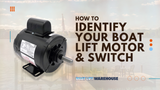
Need help identifying an existing lift motor? Read our guide to identifying your boat lift motor and switch. If you already have a wiring or motor issue, send us the motor nameplate and switch information rather than guessing at replacement parts.
Choose Your Motor First. Plan the Circuit With Your Electrician.
Boat Lift Warehouse can help identify compatible motor, hoist, and control options. Your qualified electrician should determine the final wiring method, conductor sizing, protective devices, and code-compliant installation.
Questions about a specific lift? Call 877-468-5438, contact our team, or shop PWC lifts.