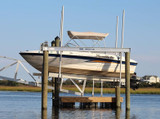
If your boat lift stops working—or you’re trying to replace a motor, wiring harness, or switch—the first step is correctly identifying the motor and switch on your lift.
This is one of the most common questions we get from boat owners. The challenge is that many lifts have been installed for years, upgraded over time, or wired differently depending on the installer. Without knowing exactly which motor and switch setup you have, it’s difficult to find the right wiring diagram or replacement parts.
To help simplify the process, we created a quick video guide that walks through how to identify your boat lift components.
Watch: How to Identify Your Boat Lift Motor & Switch
In the video, we walk through the most common types of boat lift motors and switches and show you where to look for identifying information.
Why Identifying Your Boat Lift Motor & Switch Matters
Correct identification is critical for several reasons:
- Finding the correct wiring diagram
- Ordering compatible replacement parts
- Troubleshooting electrical issues
- Upgrading to a new motor or remote system
- Ensuring safe operation around water and electricity
Boat lift motors and switches vary significantly between manufacturers, and wiring configurations are not always universal. Incorrect wiring or mismatched components can cause motor damage, electrical hazards, or lift failure.
Below is a step-by-step breakdown you can follow on your own lift.
STEP 1: IDENTIFY YOUR BOAT LIFT MOTOR
The motor is the heart of your boat lift system. Most boat lifts use an AC electric motor connected to a gearbox or drive unit.
Look for the Motor Nameplate: Start by locating the motor data plate or label. This is usually attached to the side or rear of the motor housing.
The nameplate typically includes:
- Manufacturer (e.g., Leeson, A.O. Smith, Elite)
- Horsepower (commonly 3/4 HP, 1 HP, 1.5HP)
- Voltage (110V or 220V)
- Frame type (such as C-Face or base-mounted motor) (FR56 or FR 48)
- Wiring diagram reference
These details help determine what replacement motor or wiring diagram you need.
Common Boat Lift Motor Types:
- Mount directly to a gearbox
- No base or mounting feet
- Very common on modern boat lifts
- Mounted using a metal base plate
- Uses a belt and pulley to connect to hoist.
- Often found on older lift setups
Both motor styles typically come in 3/4 HP,1 HP or 1.5 HP configurations, which are the most common power ratings for residential boat lifts.
STEP 2: IDENTIFY YOUR BOAT LIFT SWITCH or REMOTE
The switch or remote controls the direction of the motor—raising or lowering the lift. Most boat lifts come with a reversing drum switch. Remote controls are sometimes used to replace the drum switch as an upgrade.
Types of Boat Lift Switches
Maintained (Lock-On) Switch
- Handle stays in position when moved
- Lift runs continuously until switched back to neutral
Momentary (Spring-Loaded) Switch
- Handle returns to center when released
- Requires the operator to hold the switch while lifting or lowering
Momentary switches are often preferred because they reduce the risk of accidentally running the lift unattended.
Types of Boat Lift Remotes
Auto Stop Capable
- Requires a limit switch
- Programmable to stop your lift at desired point.
Standard / Non-Auto Stop
- Operator must continuously hold to operate.
STEP 3: CHECK THE WIRING CABLE
Another helpful identifier is the control cable running between the switch and the motor. Most systems use a 4-wire or 5-wire cable, depending on the motor and switch configuration. Things to check:
- Number of wires
- Wire colors
- Cable condition
This information helps determine the correct wiring diagram and compatible replacement switch.
Common Boat Lift Motor Brands
Some of the most common boat lift motor brands include:
- Leeson
- A.O. Smith / AMS (Aqua Marine Supply)
- Elite Motors
Most of these motors are compatible with a wide range of flat plate hoists and lift systems, but the wiring configuration must still match the switch setup.
Need Help Identifying Your Boat Lift Parts?
If you're unsure which motor or switch you have, our team can help. Send us photos of your motor, photos of your switch, and/or a picture of the wiring connections. Our boat lift specialists can help you identify the correct components and recommend the right replacement parts.